
Slate stakes are appealing for their raw look and their ability to structure a garden without resorting to concrete or treated wood. However, installing these natural stone elements correctly requires preparation that product sheets often summarize in just a few lines. Between the choice of the foundation bed, handling constraints, and local regulatory requirements, several parameters affect the longevity of the installation.
Drainage at the base of slate stakes: a point that technical notices underestimate
Most installation sheets recommend a simple sand bed under the sealing concrete. Feedback from landscapers since the summers of 2022-2023 nuances this approach. UNEP (National Union of Landscapers) documented in a special climate file for 2024 a net increase in cracking and delamination on stakes installed without drainage in regions subjected to heatwaves followed by violent storms.
Slate reacts poorly to rapid alternations between drying out and saturation with water. The current trend among professionals is to systematically use a draining gravel bed at the base of the stake rather than a simple sand bed. The layer of crushed gravel, placed under the sealing concrete, drains stagnant water and limits capillary rises that weaken the stone.
If you master the techniques for installing slate stakes, you know that a hole that is deep and wide enough is crucial for stability. The Edycem technical sheet specifies a hole of 25 to 40 cm deep and 30 cm wide minimum. Add a layer of draining gravel a few centimeters thick to these dimensions before pouring the sealing concrete, and you reduce the risk of climate-related pathologies.
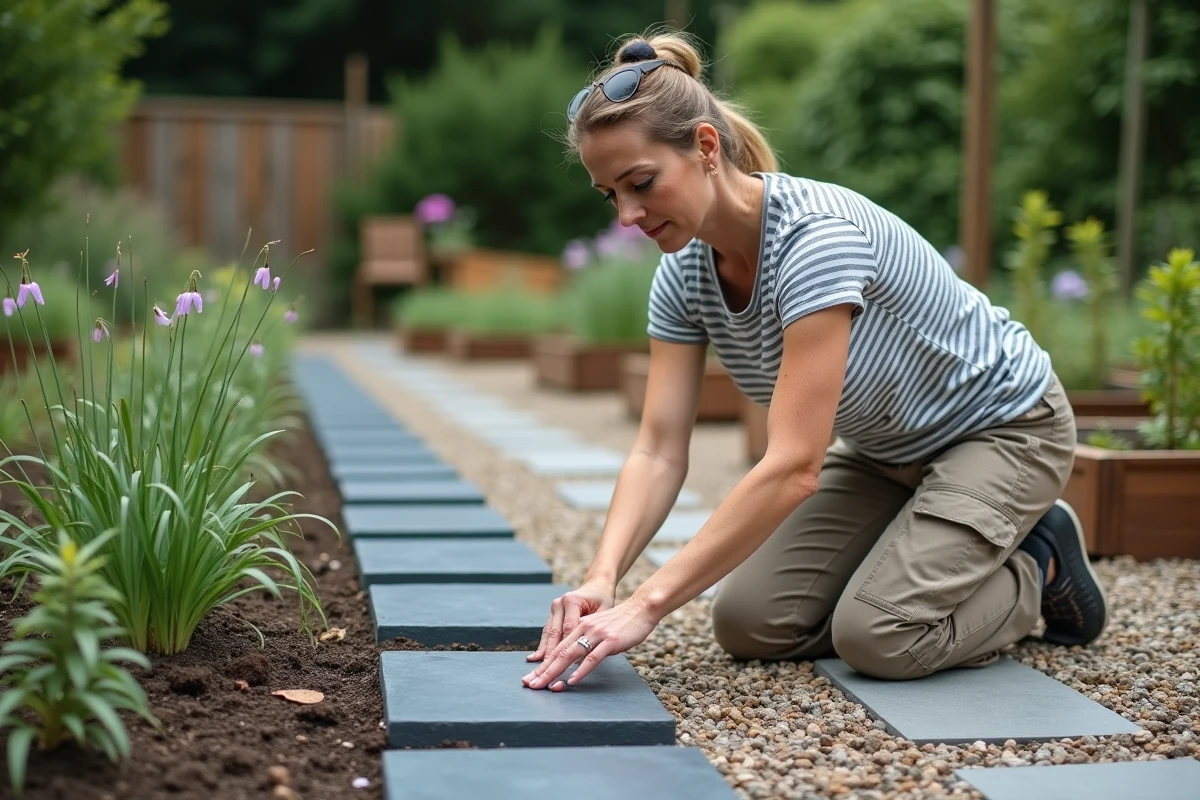
Handling slate stakes: real risks and precautions to take
A slate stake measuring 8×10 cm and 200 cm high weighs about 25 kg according to Edycem data. Handling several dozen pieces in a single day on site exposes workers to lower back pain and finger crush injuries, two types of accidents that have increased according to a note from Carsat Bretagne and OPPBTP dated 2023.
Since 2023-2024, several quarries and dealers strongly recommend the use of specific lifting clamps for stakes beyond a certain height. For an individual installing a garden border with 100 cm stakes, the risk remains moderate. However, for a slate fence with 150 or 200 cm stakes, working alone without mechanical assistance exposes one to serious injuries.
Here are some practical precautions to limit risks:
- Wear cut-resistant gloves and reinforced toe safety shoes, as slate has sharp edges on its cleavage faces
- Tip the stake from the pallet to the ground rather than lifting it overhead, using your body weight as a counterbalance
- Work in pairs as soon as the stakes exceed 150 cm in height, or use a suction lifter for the heaviest pieces
Prior declaration and PLU: when a slate stake becomes a fence
This point remains unknown to individuals installing slate stakes at property boundaries. Beyond a certain visible height, stakes are considered a fence under the Urban Planning Code. Several recent PLUs, particularly in heritage areas or near historical monuments, regulate the color and maximum height allowed.
Before ordering your stakes, consult your municipality’s PLU. In certain protected areas, only natural slate shades are accepted, and the visible height cannot exceed a locally set threshold. A prior declaration of works may be required, even for a row of stakes along a mass if it borders a public road.
Field feedback varies on this point: some municipalities strictly enforce this regulation, while others tolerate it for low-height landscaping. The safest approach is to inquire at the town hall before starting the project.
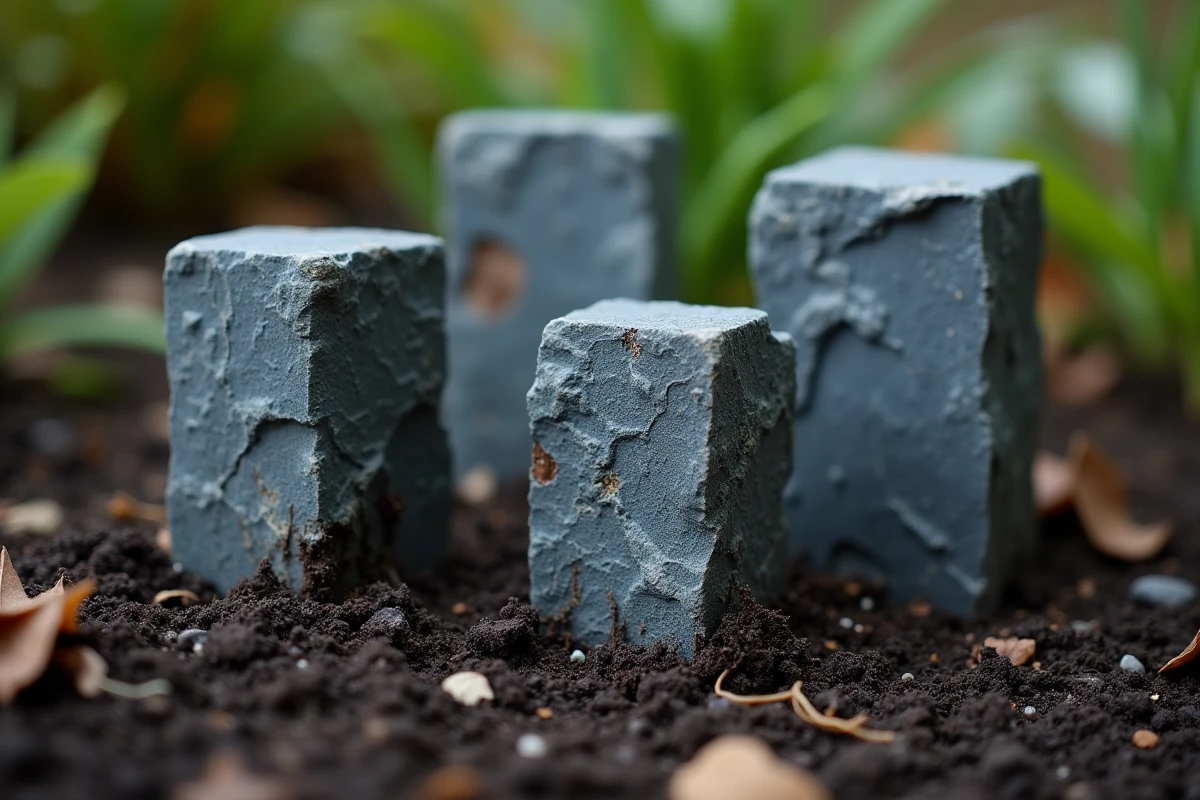
Sealing and shimming: concrete, sand, or earth depending on garden use
The choice of fixing method depends on the function of the stake in your layout. For a decorative border along a gravel path or a flower bed, a compacted earth shim may suffice if the stakes do not exceed 60 cm above ground. For a fence or a terrace separation subjected to wind or soil pressure, sealing with concrete remains the most reliable method.
The Edycem technical sheet recommends sealing to a minimum depth of 10 cm in concrete. In practice, landscapers advise burying the stake to one-third of its total height to ensure stability, including concrete. A 150 cm stake will therefore be buried about 50 cm.
For aligned installations (borders, bed delimitations), a string line stretched between two end stakes helps maintain a regular alignment. Check the verticality of each stake with a level before the concrete sets. Drying time varies depending on weather conditions, but allow at least 48 hours before stressing the structure.
Mixing stakes before installation
Slate is a natural stone that exhibits variations in color, veining, and texture from one piece to another. The Edycem sheet reminds us: mix stakes from different pallets to achieve a harmonious look. If you install all the stakes from the same pallet side by side, you risk creating uniform color zones that will contrast with the rest of the alignment.
Slate may also exhibit more or less pronounced oxidation phenomena over time. This natural patina is part of the material’s charm, but it will be more visible if the initial shades are not evenly distributed.
The success of a layout with slate stakes depends as much on the care taken with the foundation as on the choice of sealing method. A draining gravel bed, handling adapted to the actual weights of the pieces, and a quick check of the local PLU are enough to avoid the most common pitfalls on this type of project.