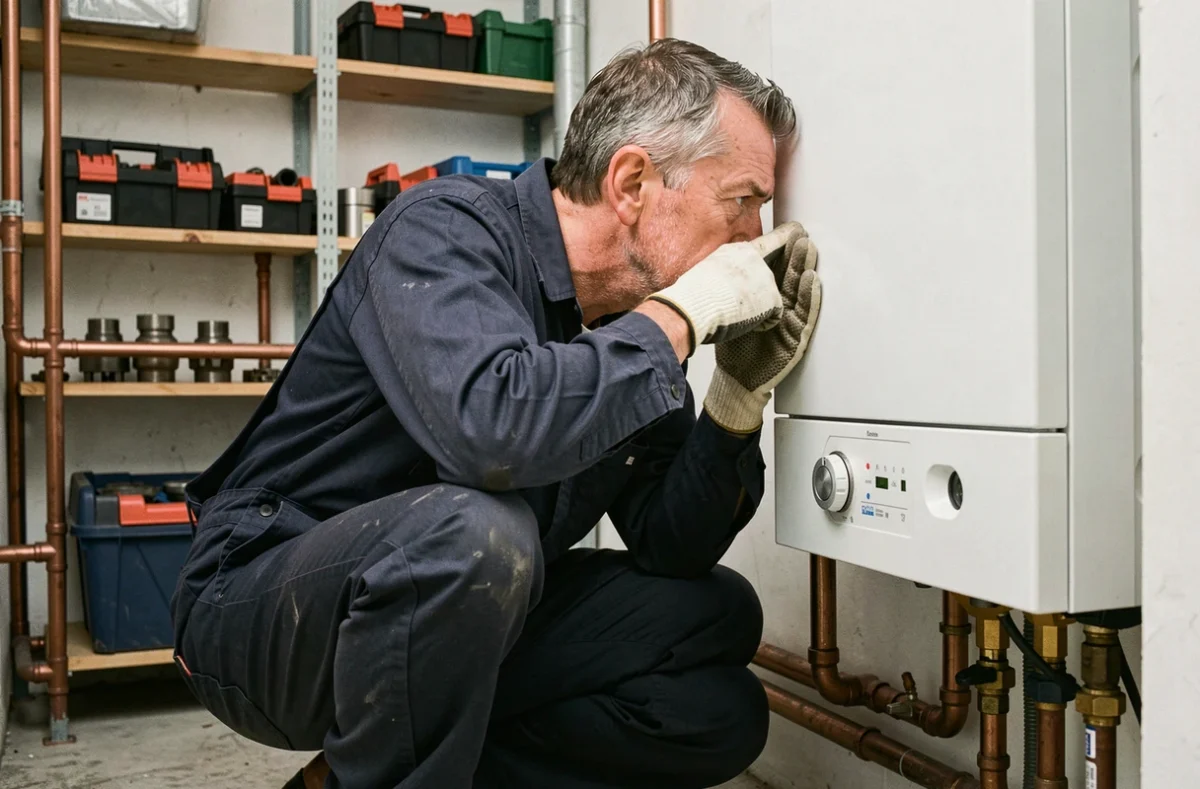
A boiler that starts to whistle or bang raises a simple question: does the noise come from the device itself or from the surrounding installation? The answer determines everything that follows, from actions you can attempt alone to calling a heating technician. Understanding the origin of the sound helps avoid two symmetrical mistakes: ignoring a real mechanical signal or replacing a part when the problem lies in the piping.
Boiler Noise: Piping Before Internal Mechanics
Most online guides directly point to a component of the boiler (heat exchanger, circulator, valve). This reflex overlooks a common cause: the noise may come from the pipes, not the boiler. When the water heats up, the copper or steel pipes expand. If they pass through a wall or are held by a collar that is too tight, the friction produces a sharp, sometimes repetitive bang.
This noise travels along the circuit and seems to come from the boiler body, while the device is functioning normally. Before suspecting an internal failure, note the exact moment when the noise occurs: at startup, during the temperature rise, or when the burner stops.
A bang that occurs a few minutes after the burner shuts off points more towards the expansion of the piping than a combustion defect. As detailed by the Infos du Jour website to consult, the location of the noise and the moment it occurs are the first two criteria for guiding a reliable diagnosis.
Boiler Whistle: Limescale or Pressure in the Heat Exchanger
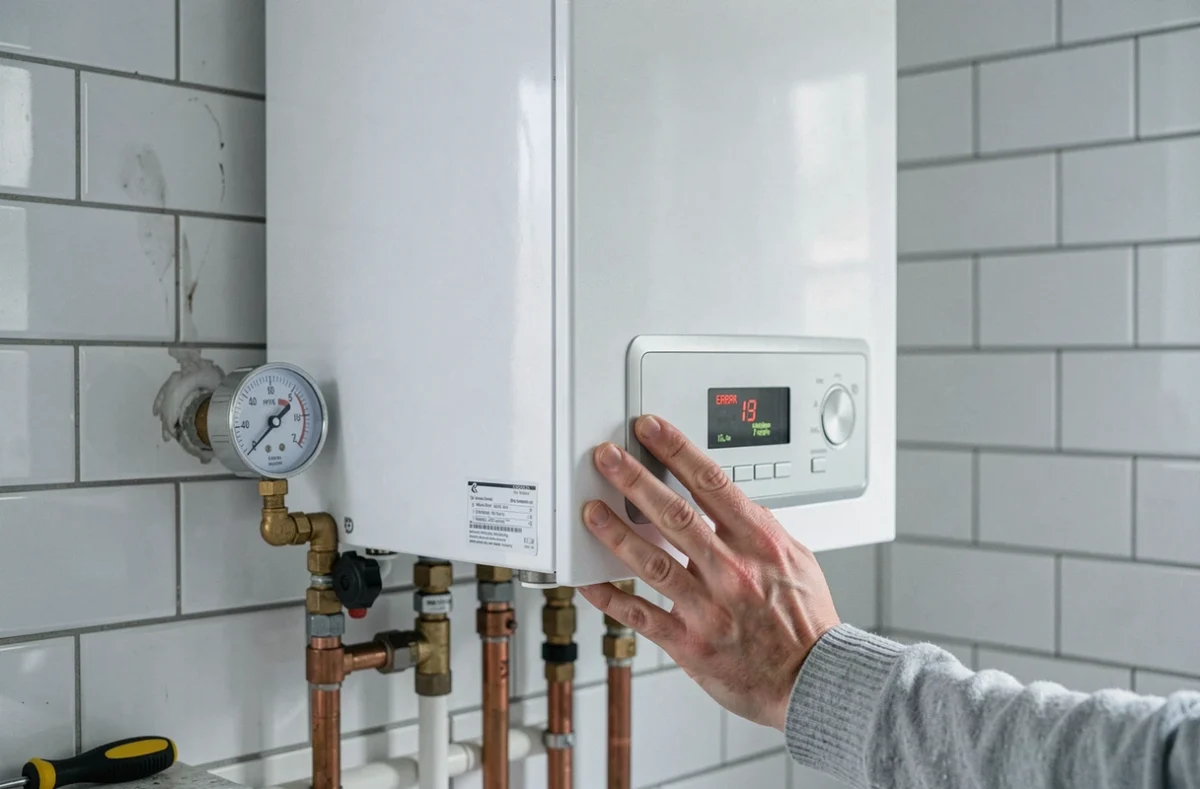
A high-pitched and continuous whistle during hot water production points to the heat exchanger. Limescale gradually deposits on the internal walls and reduces the water passage section. The flow decreases, the local temperature increases, and microbubbles of steam form and then implode upon contact with the cooler water. This phenomenon, sometimes compared to the sound of a kettle, is known as kettling in English technical literature.
The hardness of the water plays a direct role. In areas where the water is very hard, limescale build-up in the heat exchanger can become noticeable within a few years. A descaling by a professional usually resolves the issue. In some cases, replacing the heat exchanger is necessary if the limescale has damaged the heating surface.
Heating Circuit Pressure and Whistling
A pressure gauge that shows too low a pressure (below the range recommended by the manufacturer) can also cause a whistle. Water circulates poorly, the circulator strains, and the noise increases. Checking the pressure gauge is the first step to take before any other intervention. If the pressure regularly drops after being topped up, a leak in the circuit or a faulty expansion tank are the avenues to explore.
Bangs at Startup: Combustion and Ignition
A distinct bang at the moment the burner ignites falls into a different category. Gas briefly accumulates in the combustion chamber before the spark ignites it, producing a micro-explosion. Several technical causes explain this delay:
- The ignition electrode is dirty or misaligned, delaying the spark by a few fractions of a second, enough for excess gas to accumulate.
- The nozzle or injector is partially blocked, altering the air-gas mixture and making combustion less gradual.
- The gas valve has play or an internal sealing defect, releasing the fuel irregularly.
A bang at ignition warrants a quick check by a heating technician. Allowing the phenomenon to repeat can damage the combustion chamber or the heat exchanger over time.
Boiler Noise and Safety: What the Sound Doesn’t Say About Carbon Monoxide
An idea circulates: a noisy boiler would be dangerous. The reality is more nuanced. Carbon monoxide is odorless and produces no detectable noise. A perfectly silent boiler can emit CO if the flue is blocked or if combustion is incomplete. Conversely, a noisy device can operate without any toxic risk.
The decree of September 15, 2009, stipulates that the professional must measure ambient CO during the mandatory annual maintenance. In case of abnormal measurements, the device can be shut down in a situation of serious and immediate danger. Noise does not fall under this measurement protocol: it relates to comfort and mechanical maintenance, not health safety.
When Boiler Noise Masks a Real Problem
The risk is not that the noise signals an immediate danger, but that it is treated as a mere inconvenience. A whistle related to limescale, if ignored for several heating seasons, progressively degrades the heat exchanger. Efficiency decreases, gas consumption increases, and the lifespan of the device shortens. Addressing a recurring noise early costs less than a late part replacement.
Annual Maintenance and Diagnosis of Boiler Noises
The annual maintenance remains the most suitable time to report a noise to the professional. The heating technician then has the device open, measurement equipment, and can listen to the operation under real conditions. Mentioning the type of noise (continuous whistle, bang at startup, dull vibration), its frequency, and the moment it appears gives the technician concrete clues.
Some noises require no intervention. The slight humming of the circulator in operation, the click of the three-way valve switching between heating and hot water, or the sound of the fan on a condensing boiler are part of normal operation. The boundary between normal noise and suspicious noise lies in the change: a new sound, louder or more frequent than before, deserves attention.
The noise of a boiler tells as much about the state of its circuit as it does about its internal components. Noting it, situating it in time, and describing it accurately to the technician transforms a vague nuisance into a starting point for a useful diagnosis.