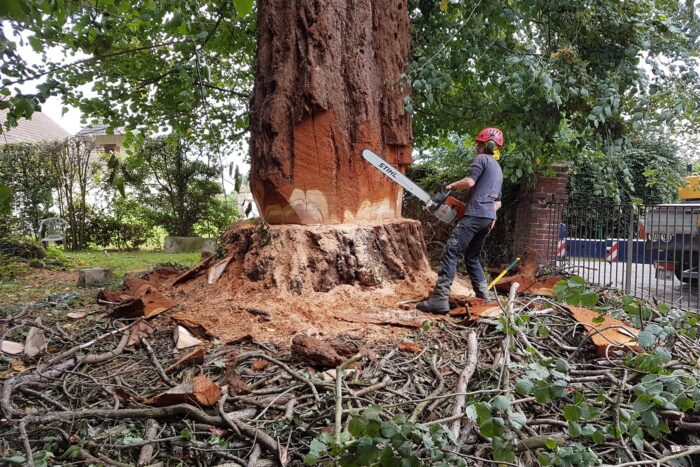
Properly felling a tree requires caution as well as the execution of good technique. It is also beneficial to have the right equipment. Do you have an oversized chestnut tree that you want to fell? Do you wish to cut down that old cider apple tree? Here’s how you could proceed.
Take some precautions before proceeding with the felling
Before felling your tree, it is important to first check that you have enough space for the tree to fall without any issues. Don’t forget to observe the passage of electrical and telephone lines. It is important that around the tree, you can clear a distance of two and a half times the height of the tree.
Additionally, make sure that no one is within the felling perimeter. This is because warning calls may be drowned out by the noise of the chainsaw at the moment. If necessary, you can plan an unobstructed escape route. Furthermore, note that certain factors could influence the direction in which the tree falls. Factors such as the natural lean of the trunk, the speed and direction of the wind, the slope of the ground, and an unbalanced branch load…
Moreover, be cautious of trees affected by rot or insects. This is because, during cutting, the trunk of these trees can split and fall suddenly and uncontrollably. It is also advisable to wear safety shoes, protective glasses, a helmet, chainsaw gloves, or handling gloves… You will also need a good chainsaw that can effectively cut the tree. If you don’t have one yet, you can find one at https://www.tronconneuse.xyz.
The technique for felling a tree

If you want to direct the fall of a fairly large tree, you can place the cable of this tree at the level of the very first branches. You will then need to secure this cable to a solid point using a winch that will be operated at the end. Thus, the directed felling is done by making a notch on the side where the tree is supposed to fall. You will need to make a first cut at a 45° angle about 30 cm from the ground, cutting one-third of the trunk’s diameter. A second cut should be made below and horizontally, to detach the portion of the trunk called the “hinge.”
After that, you will need to make a third cut called the “felling cut,” which should be made opposite the notch, thirty centimeters higher than the second cut, without reaching it. There will then be enough uncut wood between the felling cut and the notch to form the hinge that will temporarily hold the tree on the pivot. You can then clear the tools and gradually pull on the lever of the winch, which should be positioned outside the fall zone.
Always remember to plan a retreat space in case of unforeseen circumstances. When the cable tightens, a crack from the trunk of the tree will announce its fall, which will occur by breaking the hinge. The remaining part of the trunk is then reduced to ground level by making small notches all around to clear the base. You can then finish your work with a horizontal cut.